
Gutter Installation near Bethany, MO
A properly planned gutter system should do more than collect rainwater along the roof edge. For a Bethany-area home, the roofline, gutter size, pitch, fascia condition, outlet locations, downspouts, and final water-discharge areas all need to work together.
Cranmer Seamless Siding & Gutters provides Gutter Installation near Bethany for homeowners who need a new drainage system, want to replace an aging gutter setup, or need to improve how roof runoff moves away from the property.
Our gutter installation approach starts with the actual home. We evaluate the roofline, measure gutter runs, consider drainage conditions, plan outlets and downspouts, and prepare custom-fit seamless gutter runs when appropriate.
With more than 22 years of hands-on exterior experience, Cranmer helps Bethany-area homeowners make gutter decisions based on the property’s existing conditions rather than applying the same layout to every house.
Request a free project estimate to discuss your home’s gutter and drainage needs.

Get Your Free Quote
Tell us what needs to go — we’ll get back to you fast.
- 22+ Years of Hands-On Experience
- Family-Owned & Operated
- Custom-Fit Seamless Gutters
- Free Project Estimates
What Gutter Services Does Cranmer Provide?
Cranmer manages every stage of home gutter care, covering everything from regular checkups and tune-ups to fix-it work, water runoff upgrades, complete replacements, and brand-new setups.


Having an expert evaluate your gutters catches leaks, broken sections, sagging, loose fasteners, fascia rot, and water runoff issues before they turn into costly repairs.
Precision-measured to your roofline, continuous seamless gutters eliminate unnecessary seams to ensure smooth, leak-resistant runoff.


When fallen leaves, sticks, and buildup clog your troughs and downspouts, rainwater cannot drain properly. Routine cleanings quickly restore full flow to the entire system.


Isolated leaks can usually be fixed by cleaning and resealing the compromised spot, as long as the neighboring gutter metal remains in good structural condition.


Sagging or improperly sloped gutters pool water and misdirect runoff. Professional releveling quickly restores the correct gradient for smooth, guided drainage.


Leaks commonly occur around miter corners, seam joints, end caps, screws, punctures, or cracked metal. The initial priority is pinpointing exactly where moisture breaks through and what caused it.


Extensive wear, constant leaks, and recurring drainage failures signal that full gutter replacement is a smarter investment than ongoing repairs.


Built with interconnected pieces, sectional troughs offer a versatile, piece-by-piece option tailored to distinct architectural layouts and quick patch jobs.

Protective screens prevent yard waste and twigs from entering drainage channels, curbing troublesome blockages and cutting down regular system maintenance.
Suspect hail damage? We deliver complete gutter restoration across Chillicothe, MO, fixing or replacing dented troughs before leaks spread. Avoid insurance headaches—call your neighborhood specialists now.

Damaged eaves? Schedule dependable fascia board replacement in Chillicothe, MO. We install durable, rot-resistant timber and composite trim built to withstand harsh weather, protecting your roof edge and keeping your gutters securely fastened.
Downspout extensions carry roof drainage safely past your home’s perimeter, guiding discharge toward designated swales or lower-grade yard zones to prevent foundation erosion.
How Do Roof Area, Pitch & Sizing Affect Gutter Capacity?
Gutter sizing should be based on the roof and drainage conditions rather than appearance alone.
The amount of water reaching a gutter section depends partly on the roof area feeding that section. Roof pitch and geometry can also affect how quickly runoff reaches the gutter.
A roof with several slopes, valleys, or larger drainage areas may require more careful planning than a simple roofline.
Roof Area
The roof area draining toward a particular gutter run is one of the important planning considerations.
Two homes can have similar-looking roof edges but different drainage requirements because their roof shapes and runoff paths are different.
Roof Pitch
Some Princeton-area properties may have longer roof edges, mature trees, detached buildings, larger drainage areas, or longer routes between downspouts and suitable discharge locations
Gutter Dimensions
The gutter itself needs enough capacity for the roof section feeding it. Selecting a larger gutter simply because it looks more substantial is not the same as designing the system around the property’s runoff.
Roof Geometry
Corners, valleys, multiple roof sections, and changes in roof direction can concentrate water in specific areas.
Those locations deserve attention during measurement because a problem may not affect the entire gutter system equally.
Run Length
Long gutter runs also influence outlet and downspout planning. Water needs a controlled path from the roof edge toward an outlet instead of being allowed to travel an unnecessarily long distance before leaving the gutter.
The practical takeaway is simple: gutter sizing should follow the roof and drainage plan.
If your Bethany home has recurring overflow in one section, the problem may involve more than the gutter material itself. Gutter dimensions, roof runoff, pitch, outlet location, or downspout capacity may all need to be considered.
What Types of Gutter Systems Does Cranmer Install?
Different homes may require different gutter configurations. Cranmer provides seamless and sectional options along with downspouts and related drainage components.
Seamless Gutters
Seamless gutter runs are measured for the roofline and fabricated in longer continuous sections. This minimizes the number of joints across the main gutter channel.
Aluminum Gutters
Aluminum is a practical residential gutter material because it is lightweight, corrosion resistant, available in different colors, and suitable for custom seamless fabrication.
Sectional Gutters
Sectional systems consist of shorter pieces connected together. They can be useful in certain applications but contain more connection points than seamless gutter runs.
Why Bethany Homes Need Property-Specific Drainage Planning
Not every Bethany-area property handles roof runoff in the same way.
A home near I-35 may have different exposure to wind, road dust, and debris than a property farther into a rural area. An older house may have a different roofline, fascia condition, or existing downspout layout than a newer home.
That is why gutter installation should begin with the property itself.
Important conditions can include:
- The size and shape of the roof
- The length of individual gutter runs
- Roof pitch and runoff direction
- Existing gutter condition
- Fascia condition
- Location of roof valleys and corners
- Existing outlet and downspout positions
- Areas where water currently collects
- Where downspouts discharge at ground level
- Access around the home
For Bethany-area properties, the goal is not simply to add a gutter channel to the roof edge. The goal is to create a controlled path for roof water from the roofline toward an appropriate discharge area.
This approach is particularly useful for rural properties, homes with longer rooflines, and houses where an existing drainage layout has repeatedly produced overflow or water around the foundation.
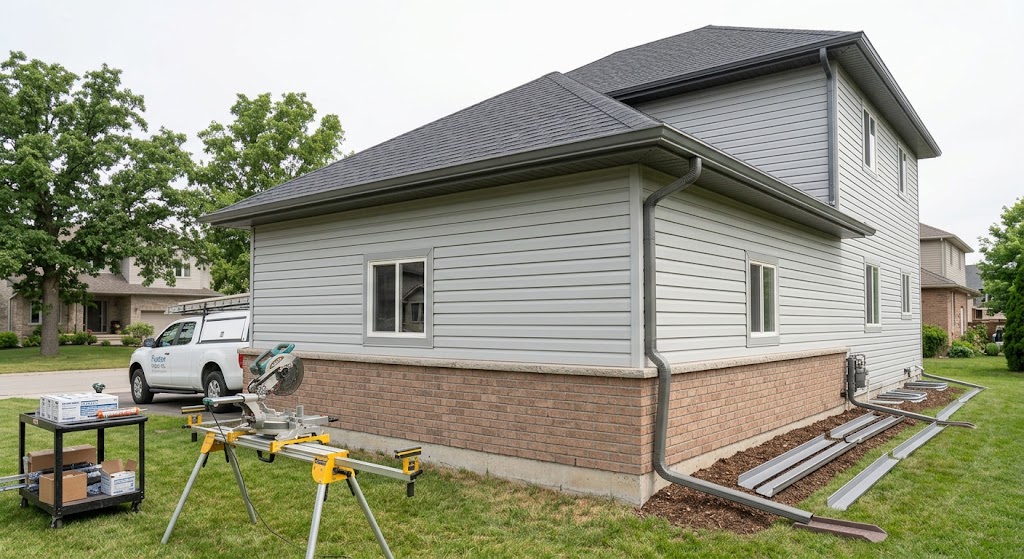

What Does a New Gutter System Actually Need to Handle?
A gutter system has several connected jobs.
First, it needs to receive water flowing from the roof. Then the gutter must carry that water along the roofline toward an outlet. The downspout then carries the water toward the ground, where the final discharge point determines where that water enters the surrounding property.
A complete system therefore includes more than the visible horizontal gutter.
Depending on the home, installation planning can involve:
- Gutter runs
- Inside and outside corners
- End sections
- Outlets
- Downspouts
- Fascia attachment areas
- Gutter pitch
- Downspout routing
- Ground-level discharge
- Optional gutter protection
- Existing drainage conditions
The roof itself is also part of the equation. Roof area, roof geometry, pitch, and the direction of runoff can influence how much water reaches particular gutter sections.
That is why a professional installation should begin with measurement and planning rather than choosing a gutter size first and attempting to make it fit afterward.
For homeowners replacing an existing system, the current layout should also be evaluated. Simply copying a poorly performing gutter configuration may reproduce the same drainage problem with new materials.
Should You Choose 5-Inch or 6-Inch Gutters?
The choice between 5-inch and 6-inch gutters should depend on the property’s roof and drainage requirements rather than a one-size-fits-all rule.
A 5-inch system may be appropriate for some residential rooflines, while a 6-inch system can provide additional capacity for homes with larger drainage areas or other conditions that justify the larger configuration.
Factors to consider include:
Roof area
Roof pitch
Roof geometry
Gutter-run length
Expected runoff
Downspout configuration
Outlet placement
Existing drainage performance
If an existing 5-inch system repeatedly overflows, replacing it with another system of the same size may not solve the underlying problem.
Likewise, choosing 6-inch gutters does not automatically correct poor pitch, inadequate downspout placement, blocked outlets, or an unsuitable discharge path.
The right size should be part of the overall drainage design.
How Should Downspout Placement & Capacity Be Planned?
Downspouts are one of the most important parts of a gutter system because they provide the route for water to leave the gutter channel.
A gutter can be properly attached to the roofline and still perform poorly if water has no efficient path toward the ground.
During installation planning, downspout locations can be considered alongside:
- Roof area feeding each gutter section
- Gutter-run length
- Roof valleys
- Outlet locations
- Gutter pitch
- Existing drainage patterns
- Fascia conditions
- Ground-level discharge areas
Avoid Treating Every Downspout Location as the Same
The best outlet location is not necessarily the location that is easiest to install.
A downspout should connect with the gutter system while also creating a practical route toward the intended discharge area.
For example, moving a downspout may help when the existing location sends water toward an undesirable area of the property. In other situations, an additional outlet or different gutter configuration may need to be considered.
Think About the Ground-Level Discharge
The downspout only completes part of the drainage path.
The water still needs somewhere appropriate to go after it leaves the vertical pipe.
If the downspout releases water directly beside the foundation, the gutter system may be collecting roof water successfully while still creating an undesirable drainage condition at ground level.
That is why gutter installation and downspout planning should be considered together.
For more detailed drainage planning, see Cranmer’s Downspout Drainage Solutions service.
Gutter Pitch, Hangers, Fascia & Drip Edge: What Matters During Installation?
A gutter system needs proper attachment and drainage direction to function as intended.
The gutter should have an appropriate pitch toward its outlet locations. The attachment method also needs to provide suitable support along the roofline. Several components can therefore affect installation quality.
Gutter Pitch
Gutters are not installed perfectly level. They need drainage direction so water can move toward the appropriate outlet.
Too little effective drainage direction can leave water standing in the gutter. Poor alignment can also contribute to water remaining in areas where it should be moving toward the downspout.
Hangers and Fastening
The gutter must remain supported along its run. Fastening and hanger placement should account for the length and configuration of the gutter rather than relying on a few attachment points.
A gutter that begins to pull away from the fascia can lose its intended drainage direction.
Fascia Condition
Fascia is especially important because gutter systems are commonly attached along the roof edge.
If the supporting material is deteriorated, installing a new gutter without addressing the underlying condition may create another problem.
If visible fascia damage is present, Cranmer can evaluate whether fascia board replacement should be considered as part of the project.
Drip Edge and Roof-Edge Conditions
The relationship between the roof edge, drip edge, fascia, and gutter affects how water enters the gutter.
A new gutter should therefore be evaluated as part of the complete roof-edge assembly rather than as an isolated piece of metal.
Service Areas
Where Does Cranmer Provide Gutter and Siding Services?
Cranmer’s Seamless Siding & Gutters proudly works throughout Chillicothe and neighboring Missouri areas. Visit our individual city pages to discover the tailored gutter and siding options offered in your neighborhood.
Chillicothe, MO
Chillicothe serves as Cranmer's main headquarters for seamless gutter installations, targeted repairs, runoff solutions, siding, and full-scope exterior services.
Cameron, MO
Comprehensive gutter and siding solutions for Cameron residents facing worn-out exterior claddings, troublesome runoff, or upcoming remodeling projects.
Princeton, MO
Dependable gutter and exterior improvements for Princeton homeowners, protecting older properties and rural residences that need modernized rainwater drainage.
Marceline, MO
Exterior and gutter services for Marceline homeowners seeking dependable drainage while maintaining the appearance of their property
Macon, MO
Complete gutter and exterior care for Marceline residents who demand reliable rainwater protection without sacrificing their home's visual appeal.
Hamilton, MO
Trusted home exterior care across Hamilton, specializing in gutters, water runoff management, fascia boards, and siding.
Trenton, MO
High-quality gutter and siding installations in Trenton designed to protect your home from heavy rainwater and exterior wear.
Milan, MO
Exterior installation and routine upkeep services for residential gutter, drainage, siding, and restoration jobs in Milan.
Bethany, MO
Comprehensive gutter and siding care for Bethany homeowners, providing skilled installations, targeted repairs, complete tear-offs, and exterior improvements.
Gallatin, MO
Professional residential gutter installations and exterior improvements serving homeowners throughout Gallatin.
Carrollton, MO
Complete gutter, runoff management, siding, and exterior services tailored for homeowners throughout Carrollton.
Kansas City, MO
Cranmer handles select gutter and exterior installations throughout the Kansas City metro. Reach out to our team to check service availability for your home.
Seamless vs. Sectional Gutters: Which Is Right for a Bethany Home?
Seamless and sectional gutters can both provide residential drainage when appropriately planned and installed.
The major difference is how the gutter runs are constructed.
Seamless Gutters
Seamless gutters use longer custom-fabricated runs measured around the property.
One advantage is fewer joints along the primary horizontal gutter channels. Fewer main-run connections can reduce the number of locations where sealing and connection details are required.
However, seamless does not mean that the entire system has zero joints.
Corners, outlets, end sections, downspouts, and other transitions still require appropriate connections.
Sectional Gutters
Sectional gutters are assembled from multiple individual pieces.
They can be suitable for certain residential projects, particularly where the homeowner’s project requirements, layout, budget, or construction approach make sectional installation appropriate.
Cranmer also provides Sectional Gutter Installation for qualifying projects.
The better choice depends on the actual home rather than the label alone.
Replacement May Make More Sense When:
- Deterioration is widespread
- Multiple sections repeatedly fail
- Long runs are damaged
- The system repeatedly pulls away
- Previous repairs are no longer practical
- The existing layout does not manage runoff effectively
New Installation May Be Appropriate When:
- The property lacks an effective gutter system
- An existing system has been removed
- A redesigned drainage layout is required
- Exterior renovation creates the need for a new roof-runoff system
The objective is to match the service to the actual condition of the property rather than using replacement as the default answer.
Aluminum, Copper, Steel & Gutter Profile Options
Material and profile selection can affect appearance, maintenance considerations, project cost, and how the finished gutter system fits the home.
Aluminum Gutters
Aluminum is a common residential gutter material and is the primary seamless gutter option offered by Cranmer.
Custom-fit seamless aluminum gutters can be prepared around the measured roofline, reducing joints along the main runs.
Copper Gutters
Copper provides a distinctive appearance and can be considered when the homeowner wants a premium architectural finish.
Cranmer offers Copper Gutter Systems for applicable projects.
Steel Gutters
Steel can also be considered for certain applications, although material selection should be based on the property’s needs and the homeowner’s priorities rather than assuming one material is universally better.
K-Style and Half-Round Profiles
The gutter profile affects both appearance and water-carrying shape. K-style gutters have a more angular appearance that commonly coordinates with modern residential trim.
Half-round gutters have a rounded appearance and may suit homeowners looking for a more traditional exterior style. The right combination of material, profile, size, and color should fit the home’s roofline and exterior design.
What Are the Signs You Need New Gutters?
Not every gutter problem requires complete replacement.
However, some conditions indicate that the existing system may no longer be practical to keep repairing.
Watch for:
- Gutters pulling away from the fascia
- Repeated leaks at multiple locations
- Frequent overflow
- Water collecting around the foundation
- Sagging gutter runs
- Persistent drainage problems
- Damaged or poorly positioned downspouts
- Old repairs or patches accumulating over time
- Gutters that no longer fit the current roofline
- Water spilling over one or more sections during rain
The location of the problem matters.
For example, overflow at one roof section may indicate a localized capacity, pitch, outlet, or downspout issue rather than failure of the entire system.
Likewise, a gutter that is visibly pulling away from deteriorated fascia may require evaluation of the supporting material before a new gutter is installed.
For homeowners unsure about the current condition, a Gutter Inspection can help determine whether repair or replacement is more appropriate.
Should You Repair, Realign or Replace Your Gutters?
The right solution depends on what is actually causing the problem.
Repair
Repair may make sense when the gutter system is generally suitable but has a localized leak, damaged connection, or isolated issue.
Cranmer provides Gutter Leak Repair for appropriate problems.
Realignment
A gutter that has shifted, tilted, or lost its intended drainage direction may not need complete replacement.
In those cases, Gutter Realignment may be worth evaluating.
Replacement
Replacement becomes more relevant when the existing system has widespread deterioration, repeated repairs, poor configuration, or drainage limitations that cannot be reasonably corrected.
A replacement project should not simply reproduce the old layout.
The new configuration can be planned around the current roofline, gutter dimensions, outlets, downspouts, fascia condition, and final discharge needs.
Cranmer’s Residential Gutter Replacement service can be considered when the existing system is no longer practical to retain.
What Happens During Professional Gutter Installation?
A professional installation should begin before the first gutter section is attached.
The planning process matters because the completed system needs to match the home’s roofline and drainage conditions.
Step 1: Review the Property
The first step is understanding the home and the reason for the project.
Useful information can include:
- Property location
- Existing gutter condition
- Number of stories
- Visible overflow
- Water around the foundation
- Downspout concerns
- Fascia condition
- Roofline configuration
- Existing drainage problems
Step 2: Evaluate the Roofline
The roofline is reviewed for gutter runs, corners, end points, roof sections, and areas where runoff concentrates.
This helps determine how the gutter system should be divided and where outlets may be appropriate.
Step 3: Measure the Gutter Runs
Measurements are used to plan the length and configuration of the system.
For seamless installation, longer runs can be prepared around the property’s measured dimensions.
Step 4: Plan Gutter Size and Drainage
Gutter dimensions, roof runoff, gutter pitch, outlets, downspouts, and discharge areas are considered together.
This is where a property-specific installation differs from simply purchasing standard gutter sections and attaching them to the roof edge.
Step 5: Check Supporting Conditions
Visible fascia condition and roof-edge details should be considered before attachment.
If the supporting material needs attention, that issue should be addressed as part of the project planning.
Step 6: Prepare the Gutter Runs
For a seamless system, longer gutter runs are custom-fabricated or prepared around the measured roofline.
Step 7: Install and Connect the System
The gutter runs are positioned and attached, with appropriate outlets and downspouts connected to establish the intended drainage route.
Step 8: Review the Completed System
The finished installation should be reviewed for alignment, attachment, drainage configuration, and completion of the agreed scope.
The goal is not simply to have new gutters on the house. The goal is to have a drainage system that makes sense for the roofline and property.
What Determines Gutter Installation Cost near Bethany?
There is no single responsible price for every Bethany gutter installation because homes vary significantly in size, roof configuration, accessibility, and drainage requirements.
Instead, the estimate should account for the actual project.
Important cost factors can include:
Linear Feet
The total length of gutter runs affects the amount of material and installation work required.
Number of Stories
Multi-story homes can involve different access requirements from single-story properties.
Roofline Complexity
Corners, multiple roof sections, valleys, unusual roof geometry, and long runs can increase planning and installation complexity.
Gutter Construction
Seamless and sectional systems use different installation approaches and material configurations.
Material
Aluminum, copper, steel, and other material choices can affect the overall project.
Downspouts
The number, size, location, and routing of downspouts can influence the scope.
Extensions and Drainage Work
If water needs to be carried farther from the home’s foundation, downspout extensions or other drainage improvements may become part of the project.
Gutter Guards
Adding gutter protection can increase project scope depending on the existing or new gutter configuration.
Fascia Condition
If the supporting fascia requires replacement or repair, that work can affect the overall estimate.
Removal of Existing Gutters
Replacing an existing system can involve removing old gutter runs and components before installing the new system.
Because these factors vary by property, the most useful next step is a project-specific estimate rather than relying on a generic per-foot number.
Should You Add Gutter Guards?
Gutter guards can reduce the amount of leaves and larger debris entering a suitable gutter system.
They are especially worth considering when debris regularly accumulates in the gutter or when the homeowner wants to reduce the frequency of gutter cleaning.
However, gutter guards should not be used to hide an existing gutter problem.
Before installation, the gutter system should be suitable for protection. Alignment, gutter condition, outlet access, and drainage performance should be considered first.
Cranmer provides Gutter Guard Installation for applicable systems.
A guard can help manage debris, but it does not replace proper gutter sizing, pitch, downspout planning, or final water discharge.
Downspout Extensions & Final Water Discharge
The drainage system does not end when water exits the downspout.
The final discharge location matters because concentrated roof runoff released beside the foundation can create an undesirable drainage condition.
Depending on the property, a downspout may need an extension to move water farther from the house.
An extension can be useful when:
- Water is discharged too close to the foundation
- Soil is being washed away near the downspout
- Water repeatedly collects beside the home
- The existing discharge direction is inconvenient
- Roof runoff needs to reach a more suitable drainage area
Cranmer provides Downspout Extension Installation for appropriate projects.
The extension should be considered as part of the entire drainage route rather than as an unrelated accessory.
Gutter Installation near Bethany & Harrison County
Cranmer serves Bethany-area homeowners and nearby communities in Harrison County with gutter, drainage, siding, repair, replacement, and related exterior services.
Bethany properties can vary considerably.
A home close to I-35 may have different exposure to road dust, wind, and debris than a rural property surrounded by open land. Older homes may also have different roof-edge, fascia, or gutter configurations than newer construction.
For that reason, local service should still begin with the individual property.
Cranmer can evaluate:
- Existing gutter condition
- Roofline configuration
- Downspout placement
- Visible fascia condition
- Drainage concerns
- Overflow locations
- Water-discharge areas
- Gutter replacement needs
- New gutter installation requirements
The current service-area information also identifies Bethany among the communities served by Cranmer.
If your home is outside Bethany but within the surrounding service area, contact Cranmer to confirm availability for your property.
Why Choose Cranmer for Gutter Installation?
A gutter installation project requires more than selecting a gutter color.
The system has to fit the roofline, provide an appropriate drainage path, connect to suitable downspouts, and work with the home’s existing exterior conditions.
Cranmer brings more than 22 years of hands-on exterior experience and operates as a family-owned business. The company’s current gutter service includes custom-fit seamless gutters, free project estimates, gutter replacement, repairs, drainage improvements, gutter protection, fascia services, and related exterior work.
Custom-Fit Seamless Options
Longer seamless gutter runs can be measured and prepared around the home’s roofline, reducing joints along the main horizontal channels.
Property-Based Planning
Roof area, gutter dimensions, roof geometry, outlets, downspouts, fascia, and discharge conditions can all be considered before installation.
Complete Gutter Services
If the home needs more than a new gutter channel, related repair, replacement, drainage, fascia, or gutter-protection services can also be evaluated.
Free Project Estimates
Homeowners can discuss their property and receive a project-specific estimate before deciding on the work.
Related Gutter & Exterior Services
A new gutter system is sometimes only one part of a home’s exterior drainage needs.
Depending on the condition of the property, you may also want to explore:
- Gutter Inspection — evaluate visible gutter and drainage conditions before deciding on larger work.
- Gutter Cleaning — remove accumulated debris from suitable existing gutter systems.
- Gutter Leak Sealing — address appropriate localized sealing needs.
- Gutter Leak Repair — repair suitable gutter leaks.
- Gutter Realignment — correct certain alignment and drainage-direction problems.
- Residential Gutter Replacement — replace an existing system when repair is no longer the practical solution.
- Fascia Board Replacement — address deteriorated supporting material when needed.
- Gutter Guard Installation — add gutter protection to suitable systems.
- Downspout Drainage Solutions — improve the path from gutter outlets to final discharge.
- Downspout Extension Installation — carry discharge farther from the home where appropriate.
Our Happy Customers
What Do Homeowners Say About Cranmer?
 Posted on Google

 Seth BeVelle
Trustindex verifies that the original source of the review is Google.
Excellent work. Dedicated Crew! Couldn’t be happier with the whole process! HIGHLY RECOMMEND!!Posted on Google Beverly CaselmanGreat job. Timely and honest.Posted on Google
 Ross WoodWorked with them a couple years ago on my dad's house. They were very professional and maintained communication the entire time and were able to work with us on pricing and payments. They cleaned up after themselves and didn't leave a mess. I would definitely recommend them to anybody in the area that needs work done on their home.Posted on Google
 Dean McAdamsCrammer's did a great job installing our siding price was reasonable , and I have had so many people liking the look of my house followup service was excellentPosted on Google
 Jason CroweThey did a wonderful job for us. Our new guttering looks and works great!Posted on Google
 Carolyn GreenwoodGreat experience! Responded very quickly to my request and guttering was installed perfectly…and in a very timely manner! Couldn’t have asked for anyone better!Posted on Google
 Brice PotterVery easy to deal with. I have used them a couple times and would recommend them to anyone.Posted on Google
 Joe MarshallGreat, reliable and experienced. Did a great job for me.Posted on Google
 Carl McbeeWe used Cranmer's on a guttering job on our building and it was a super easy process. Price was very reasonable and the workers were quick to get the job done. Would definitely recommend.Posted on Google
 Don HeadWe had Cranmer's install siding and seamless gutters/leaf guard on our house and gutters/leaf guard on 2 outbuildings. Very happy. All were done in a timely and professional manner. They cleaned up the mess and hauled off all the old material when they were finished. We would recommend Cranmer's to anyone.Verified by TrustindexTrustindex verified badge is the Universal Symbol of Trust. Only the greatest companies can get the verified badge who has a review score above 4.5, based on customer reviews over the past 12 months. Read more

FAQ
Frequently Asked Questions About Gutter Installation near Bethany
Look at the overall condition rather than one isolated problem.
If the system has several leaking areas, widespread sagging, repeated overflow, damaged runs, poor downspout placement, or old repairs throughout the gutter network, replacement may make more sense than continuing to patch individual areas.
A gutter inspection can help determine whether the current system is still practical to repair.
Yes. Older homes can receive new gutters, but the installation should account for the existing roofline and supporting conditions.
The roof geometry, fascia condition, existing gutter configuration, downspout locations, and visible drainage problems should be reviewed before installation.
If fascia has deteriorated, that condition may need to be addressed before new gutters are attached.
They can be.
Rural properties may have longer rooflines, larger open areas around the home, different access conditions, or different options for where downspouts can discharge.
The important point is not that every rural property needs a particular gutter size or layout. The system should be planned around the actual roof and surrounding drainage conditions.
Localized overflow does not necessarily mean the entire gutter system is too small.
The affected section may be receiving a larger amount of roof runoff because of a valley or roof configuration. Other possibilities include insufficient gutter pitch, a blocked outlet, an unsuitable downspout location, or inadequate capacity for that particular roof section.
The affected area should be evaluated before replacing the entire system.
In many cases, downspout locations can be incorporated into a new drainage layout.
The new position should consider the gutter run, roof runoff, outlet location, fascia, vertical routing, and final ground-level discharge.
Moving a downspout simply for appearance without considering where the water will ultimately go can create a different drainage problem.
Pulling away can indicate an attachment, support, alignment, or underlying fascia problem.
If the fascia itself is deteriorated, installing a new gutter directly onto the same damaged support may not address the underlying condition.
The fascia and gutter should therefore be considered together when the system is being replaced.
No.
Seamless gutters reduce the number of joints along the primary horizontal gutter runs because longer sections are custom-fabricated for the property.
However, corners, outlets, end areas, downspout connections, and other transitions still require appropriate connections.
The main advantage is reducing joints along the long gutter runs, not creating a completely joint-free drainage system.
Material selection depends on the home’s appearance, project requirements, budget, and the type of gutter system being considered.
Cranmer’s residential gutter offering includes custom seamless aluminum systems. Copper can also be considered for homeowners seeking a distinctive architectural finish.
The material should be selected together with gutter size, profile, roofline configuration, and drainage requirements.
Gutter protection can be considered as part of a new installation when the selected system is suitable for it.
The gutter size, roofline, debris conditions, outlets, and overall drainage design should be reviewed before adding protection.
A gutter guard is intended to help manage debris entering the gutter; it does not replace proper sizing or downspout planning.
Look beyond the gutter itself.
If water is leaving the downspout directly beside the foundation, pooling in one area, washing soil away, or moving toward an undesirable part of the property, the issue may involve the discharge route rather than the gutter channel.
In that situation, the gutter, downspout, extension, and final discharge area should be considered as one system.
Not necessarily.
Downspout planning should relate to the amount of roof runoff entering the gutter section, the gutter configuration, outlet locations, and the property’s drainage conditions.
Simply installing larger downspouts without evaluating the roof and gutter layout does not automatically create a better system.
Useful information includes:
- Property location
- Number of stories
- Whether gutters are already installed
- Areas where overflow occurs
- Visible leaks or sagging
- Downspout concerns
- Water collecting near the foundation
- Visible fascia damage
- Whether you are considering seamless or sectional gutters
- Photos of problem areas, when available
This information helps establish what should be evaluated during the project.
Yes, a new gutter system can be planned for a home that does not currently have effective gutters.
The roofline, gutter runs, outlets, downspouts, fascia, and final water-discharge areas should be considered before installation.
Adding gutters to a home for the first time is an opportunity to create the drainage layout around the current property rather than inheriting an older configuration.
Yes.
Roof pitch can affect how runoff reaches the gutter and therefore becomes part of understanding the drainage requirements for each roof section.
However, roof pitch is only one factor. Roof area, roof geometry, gutter dimensions, gutter-run length, outlet positions, downspouts, and final discharge conditions should also be considered.
The entire drainage path should be reviewed.
The gutter may be collecting water correctly while the downspout is releasing it too close to the home. In other cases, the outlet position, downspout routing, extension, or surrounding grade may contribute to the problem.
A new gutter installation should therefore include a plan for where collected roof water will ultimately go.
Standard gutter sections do not automatically account for the specific roofline.
A professional installation considers the property’s measurements, gutter-run lengths, corners, roof geometry, fascia, outlets, downspouts, pitch, and final discharge locations.
That property-specific planning is especially important when the existing system has a history of overflow, leaks, poor drainage, or unsuitable downspout placement.
Plan Your Gutter Project Around the Actual Roofline
A successful gutter project starts with the home, not with a standard gutter size.
The roof area, pitch, gutter runs, fascia, outlets, downspouts, discharge locations, and existing drainage conditions all influence what the property needs.
If your Bethany-area home has leaking or sagging gutters, recurring overflow, water near the foundation, or no effective gutter system at all, Cranmer Seamless Siding & Gutters can evaluate the property and discuss the appropriate installation, repair, replacement, or drainage solution.
With more than 22 years of hands-on exterior experience, Cranmer provides custom-fit seamless gutter options, gutter replacement, repairs, drainage solutions, gutter protection, and related exterior services.
Request your free project estimate and let the gutter system be planned around your home’s actual roofline and drainage needs.
Serving Chillicothe,
Missouri & Nearby Areas
Phone Number
816-262-4383
Request Your
Free Estimate Today
Cranmer Seamless Siding & Gutters
Gutter Installation near Bethany, MO
A properly planned gutter system should do more than collect rainwater along the roof edge. For a Bethany-area home, the roofline, gutter size, pitch, fascia condition, outlet locations, downspouts, and final water-discharge areas all need to work together.
Cranmer Seamless Siding & Gutters provides Gutter Installation near Bethany for homeowners who need a new drainage system, want to replace an aging gutter setup, or need to improve how roof runoff moves away from the property.
Our gutter installation approach starts with the actual home. We evaluate the roofline, measure gutter runs, consider drainage conditions, plan outlets and downspouts, and prepare custom-fit seamless gutter runs when appropriate.
With more than 22 years of hands-on exterior experience, Cranmer helps Bethany-area homeowners make gutter decisions based on the property’s existing conditions rather than applying the same layout to every house.
Request a free project estimate to discuss your home’s gutter and drainage needs.
Get Your Free Quote
Tell us what needs to go — we’ll get back to you fast.
Why Bethany-Area Homeowners
Choose Cranmer Seamless Siding & Gutters
Your home needs exterior work that can handle highway-area weather, open-lot exposure, and changing Missouri seasons. Cranmer focuses on clean workmanship, strong materials, and practical drainage planning that protects your home for the long run.
What Sets Us Apart:
I-35 Area Drainage Focus
We provide I-35 area gutter installation service for homes that deal with wind-driven rain, road dust, and fast roof runoff.
Harrison County Water Planning
We support Harrison County home drainage with gutter slope, downspout direction, and runoff control built around your property.
Seamless Gutter Systems
We install seamless gutter systems that reduce weak joints and help water move more smoothly.
Strong Storm Protection
Our work supports storm protection for home exteriors by helping reduce leaks, overflow, and water damage.
Trusted Local Service
You get practical guidance from trusted gutter installers near Bethany MO with 22+ years of exterior experience.
If you want to know what your home needs before repairs grow, you can schedule a closer gutter inspection and get clear recommendations from a local team.


Professional Siding Installation near Bethany, Missouri
Your siding protects your home from rain, wind, road dust, pests, and daily weather wear. When siding cracks, fades, loosens, or warps, your walls can lose both protection and curb appeal. Bethany-area homes near open roads or rural land need siding that looks clean and holds up well.
Our Siding Services Include:
- New Vinyl Siding Installation
- Full Siding Replacement
- Repair of Damaged or Warped Panels
- Energy-Efficient Exterior Upgrades
- Custom Color Selection
Cranmer helps you update your exterior without making your home look mismatched. Better siding can reduce upkeep, improve comfort, and help your home stay protected through Missouri’s changing seasons.
Seamless Gutter Installation near Bethany MO
(Cleaner Runoff. Stronger Home Protection.)
Your gutters should move rainwater away from your home before it reaches your siding, landscaping, basement area, or foundation. When gutters leak, sag, or overflow, water can damage fascia, soften soil, and create moisture concerns.
Our seamless gutter systems help reduce those risks.
What You Get:
- Gutter installation near Bethany
- Clean roofline drainage solutions for better water flow
- Durable gutter replacement for worn or failing systems
- Multiple color choices to match your exterior
We install gutters that help protect your home with fewer weak points and better runoff direction. If your current gutters fail during storms, our seamless gutter installation service can improve foundation water control and reduce repeat drainage problems.

Multiple Color Options to Match Your Bethany-Area Home
Your siding and gutters should protect your home while still looking clean from the street. Cranmer offers color choices that help your exterior match your roof, fascia, trim, and home style.
- Improve curb appeal with a cleaner exterior finish
- Match gutters, siding, trim, and roof colors
- Add long-term value with a polished home exterior
Ask about available colors during your free estimate. The right color choice can make your new siding and gutters look natural, balanced, and well planned.
Our Process
Our Proven Process
(Planned for Roadside Weather. Installed for Lasting Flow. .)
You need more than a quick installation. You need a process that checks water flow, home style, and weather exposure before work begins. Cranmer keeps each Bethany-area project clear, organized, and focused on lasting protection.
Simple, clear, and done right—start your project today.
Proudly Serving Bethany, Missouri & Nearby Areas
Cranmer serves homeowners near Bethany, MO, and nearby Harrison County communities with siding and gutter solutions built for local homes.
We understand common Bethany-area exterior needs:
- Homes near I-35 that face wind, road dust, and debris
- Rural properties needing better rainwater direction
- Rooflines that need stronger drainage during storms
That is why we install systems built for real Missouri conditions. If your gutters sag, tilt, or drain poorly, our gutter realignment service can help restore flow before water damage spreads.
Local experience matters. Call Cranmer Seamless Siding & Gutters today.
Warning Signs You Need New Siding or Gutters
(Don’t Ignore These)
If you notice these problems around your Bethany-area home, your exterior may need service soon.
Water collecting near your foundation
Gutters pulling away after storms
Siding stained by runoff or road dust
Overflow near driveways or walkways
Repeated leaks around corners
Frequent leaks may mean you need an affordable rain gutter service instead of another short patch.
These warning signs can grow fast. Fix them early before they become costly repairs.
Frequently Asked Questions (FAQs)
You may need new gutters if they leak, sag, overflow, or pull away. Water near your foundation is another strong sign that your drainage system needs help.
Yes. Cranmer serves Bethany and nearby Harrison County areas with siding and gutter installation support. You get clear guidance and dependable workmanship.
Yes. Seamless gutters reduce weak joints and help water move better during storms. They work well for homes exposed to wind, rain, and road debris.
Yes. Proper gutters and downspouts move rainwater away from your home. That supports foundation water control and helps reduce soil washout.
Yes. Cranmer installs durable materials with careful slope and downspout planning. This helps your gutter system perform better through Missouri weather.
Yes. Cranmer can upgrade siding and gutters together. This helps your home look cleaner and perform as one complete exterior system.
Take Action Before the Damage Gets Worse
You have two choices:
- Keep waiting and risk higher repair costs.
- Fix the issue now and protect your home.
At Cranmer Seamless Siding & Gutters, we provide long-term exterior solutions, not quick patches. If your Bethany-area home needs I-35 area gutter installation service, siding replacement, or stronger drainage, now is the time to act.
Do not wait for the next storm to prove the problem again. Protect your home with siding and gutters built for Missouri weather and highway-area exposure.
Don’t wait—your home is either protected or at risk. Choose wisely.